
Two users open the same AI feature in your product today.
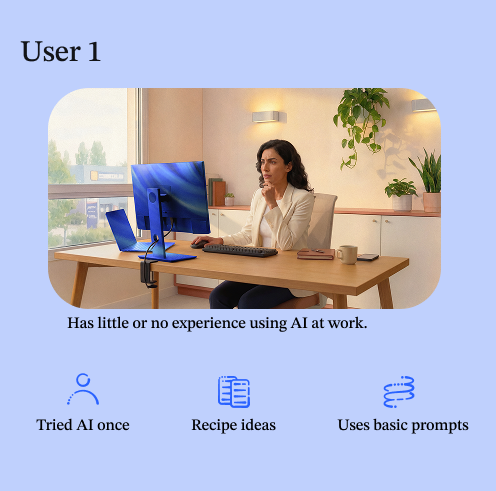
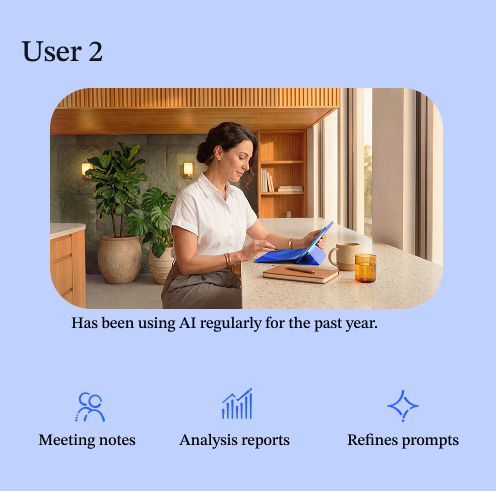
Both users are about to go through the same onboarding experience, receive the same level of support, and face the same assumptions about what they already know.
This should bother us more than it does.
We’ve been tracking usage for a while: clicks, feature adoption, session counts. All of it tells us that people are using our products. But none of it tells us how they’re doing it. A user clicking “Ask AI” could be someone who understands exactly what they’re asking for and double-checks everything that comes back, or someone who’ll copy-paste the first answer straight into a client report without a second glance. From the logs alone, they look identical.
Therefore, before we can design AI features that truly adapt to our users (not the users we imagine, but the ones we actually have), we must first answer a much more complex question: To what extent is our user base actually ready for AI?

The Trap We Almost Fell Into
When we set out to find out how well our users can handle AI, our first instinct was the most obvious one: ask people how often they use AI tools, and rank them from “never” to “regularly.” Simple, fast, done. Except it’s wrong.
Imagine two users:
- One opens a chatbot every morning to ask the same kind of simple question, day after day, for a year.
- The other opens an AI tool once a month, but the one time they did so, they imported a spreadsheet with 2,000 rows and asked it to identify anomalies across three reporting periods.
If we consider only frequency, the first user seems more advanced. In reality, the second user has gone somewhere the first one never has. Frequency measures habit. It does not measure depth. And it is depth that really matters when deciding what level of AI complexity a product can safely expose its users to, or how much guidance a new feature needs before it is well received.
What the EU and the Industry Already Agreed On
Before we created our own scale from scratch, we looked for one that already existed, because reinventing a maturity model from scratch is a surefire way to end up with something that no one trusts.
Two frameworks stood out. The European Commission’s DigComp 3.0 defines digital competence across four tiers ( Basic, Intermediate, Advanced, and Highly Advanced) built around task complexity and autonomy. On the more AI-specific side, Learnist’s AI Proficiency model sorts workplace AI use into Beginner, Intermediate, and Advanced, with a sharp point buried in its methodology: proficiency should be judged by task complexity, critical thinking, and review habits; never by confidence alone That last line became something close to a guiding principle for everything that followed. Confidence lies. Behavior doesn’t.
From Beginner to Expert: What Actually Separates Them
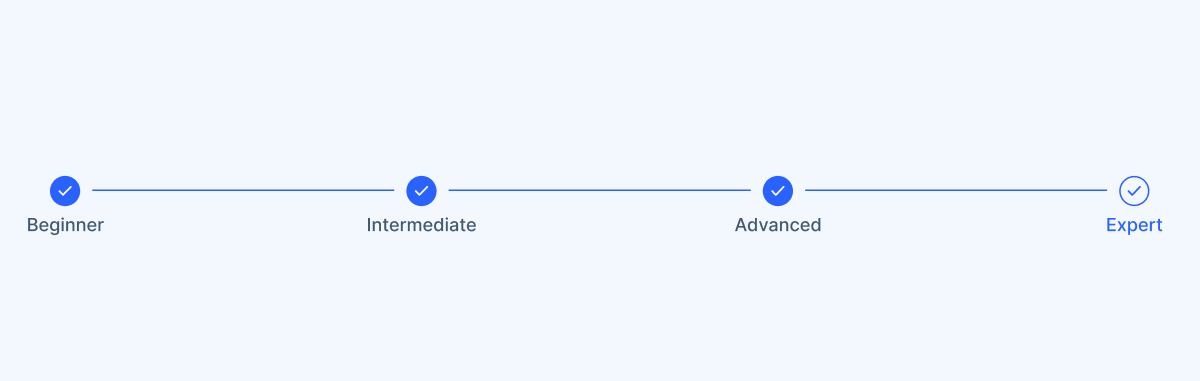
Guided by what these two frameworks had already validated, we defined four levels of our own, each built around a simple test: what’s the most complex thing this person has actually done with AI, and do they check their own work?
- Beginner: Uses AI occasionally, or doesn’t use it at all at work. When they do, it involves simple questions and answers (the chatbot equivalent of asking a coworker a quick favor). They don’t verify outputs, either trusting them blindly or distrusting them to the point of avoiding the tool entirely. The underlying mechanics of AI (and where it tends to fail) remain a mystery;
- Intermediate: Has already moved beyond the “simple chat” stage, that is, summarizing, rewriting, and refining a draft. They have a vague sense that AI can make mistakes, but do not consistently double-check the results provided by AI;
- Advanced: Regularly assigns more demanding tasks to the AI, such as analyzing files, cross-referencing data, and generating comprehensive reports. Most importantly, they verify the results before using them to make any concrete decisions. They understand the tool’s limitations well enough to work around them, rather than simply working within them;
- Expert: They don’t wait to be told what to do. They actively seek out new ways to integrate AI into their workflow, treating it less as a tool they can use when needed and more as something that has already been fully integrated into their workflow. Its use is continuous, not occasional. AI has quietly become an integral part of the way work is done.
Not Every Answer Counts the Same
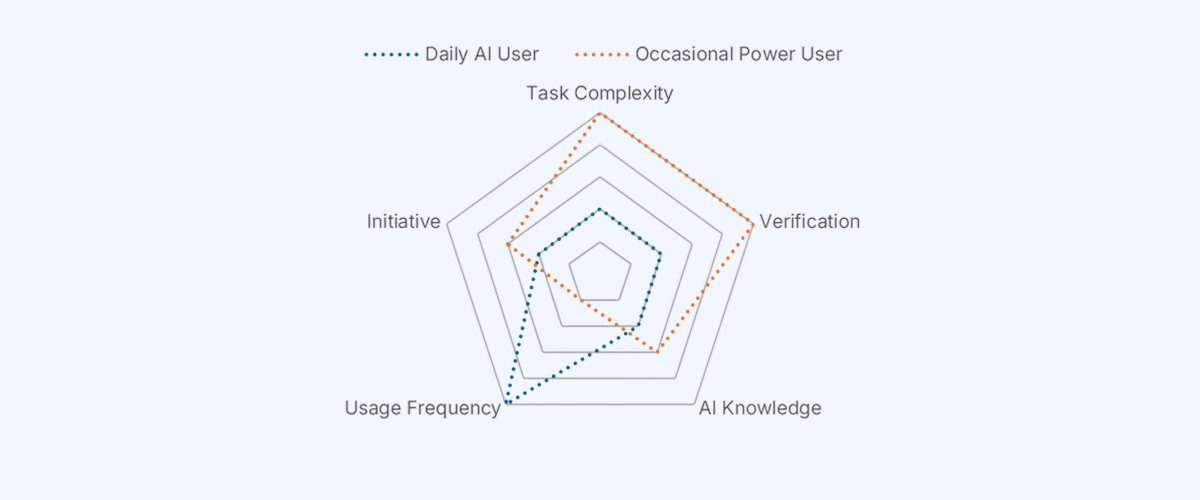
We didn’t just ask a single question and pigeonhole users based on their answers. That would have been too simplistic and risky, given that we really wanted to get to know our users. We asked five questions, each exploring a different aspect of behavior:
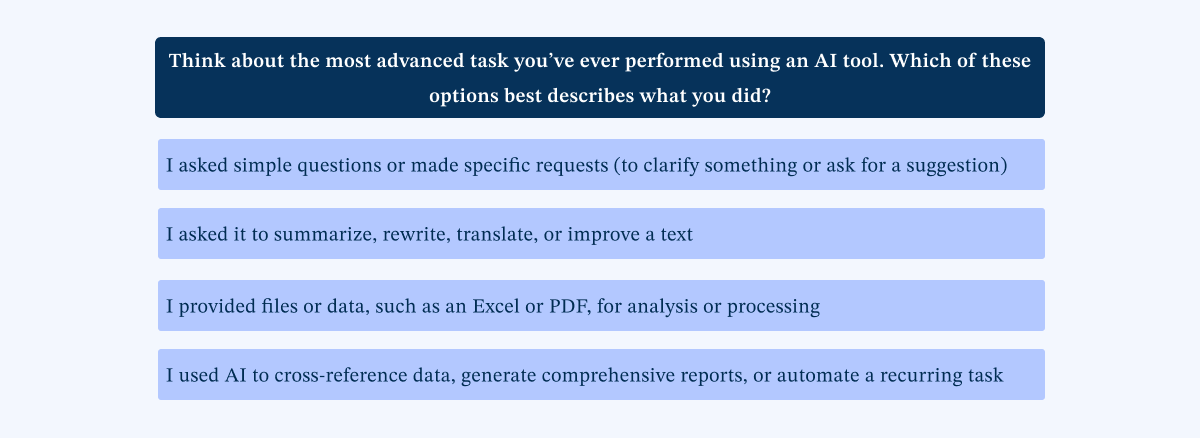
- The most difficult task they’ve ever performed with AI;
- Whether they verify the result or trust it unquestioningly;
- Whether they understand why AI sometimes confidently makes things up;
- How often they use it;
- Whether they seek out new use cases or wait for someone to show them.
Not every dimension carries the same weight in the final picture. What someone has actually done with AI (and whether they can verify their own work) is more important than what they simply know or think about the subject. Initiative is also important, but it only becomes truly significant once someone has moved beyond the basics; it’s not something we expect from a Beginner, so it shouldn’t significantly influence the score in the early stages. And frequency, the metric everyone instinctively turns to first, turned out to be the least important of all, precisely for the reason described above: using something every day proves nothing about whether you’re using it well.
No Shortcuts to Expert
Here’s the part we’re most careful about, because it’s also the part most likely to go quietly wrong.
A user may present a seemingly solid profile, that is, frequent use, solid theoretical knowledge of AI’s limitations, and a generally positive attitude, and yet have never gone beyond asking a simple question to a chatbot. If we add all of this up, that profile might seem like an Intermediate level, perhaps even Advanced. In reality, however, this user is a Beginner.
Therefore, the assessment is not simply a combination of everything a person reports about themselves. The complexity of the task they actually performed sets a strict upper limit on the level at which they can be classified, regardless of the rest of their answers. Someone who has never gone beyond a basic question can reach the Intermediate level, but no higher than that, regardless of how often they access AI or how fluently they can explain what AI hallucination is. Someone who has worked with real files and data can climb even higher, but Expert status is reserved for those who have also demonstrated what cannot be simulated by knowledge alone: actively seeking new ways to use the tool on their own initiative.
This single rule exists to protect the study from its own biggest risk: mistaking enthusiasm, confidence, or frequent-but-shallow use for genuine maturity. It’s the difference between a model that flatters respondents and one that actually reveals something true.
Turning Theory Into Six Real Questions
All this theory eventually had to become six real questions in front of real users. The survey opens with a simple gate: has this person ever used an AI tool at all? If not, there’s nothing more to ask; the survey ends there, gracefully, rather than forcing someone to answer five questions about a tool they’ve never touched.
From there, each question was written to read like something a person would naturally say about their own week, not like a technical self-assessment.
- “Think about the most advanced task you’ve ever performed using an AI tool”, rather than “rate your AI proficiency from 1 to 10.”
- “When you use an AI-generated result, what best describes what you usually do?”, rather than “how much do you trust AI?”
The goal was to ensure that each question referred to something the respondent could point to and remember having done, rather than something they would have to guess or exaggerate. It is harder to lie about behavior than about opinions, and designing the survey with that goal in mind was as deliberate a choice as any other aspect of the underlying scoring logic.
What the Results Reveal
Out of a total of 747 survey responses collected, 617 users were ultimately assigned an AI maturity level following a consistency review.
The survey was distributed across five markets: Portugal, Spain, Angola, Mozambique, and Cape Verde. Following the consistency review, we were able to assign AI maturity levels to 617 users across these markets, with the following distribution:
- Portugal: 299 users;
- Spain: 280 users;
- Angola: 27 users;
- Mozambique: 9 users;
- Cape Verde: 2 users;
Portugal and Spain together account for 94% of the assessed users, providing a considerably stronger sample for analyzing AI maturity patterns and drawing meaningful conclusions about these two markets. While the results from Angola, Mozambique, and Cape Verde are also included in the overall assessment, their smaller sample sizes mean that market-specific findings should be interpreted with caution.
The results were more encouraging than we might have expected.
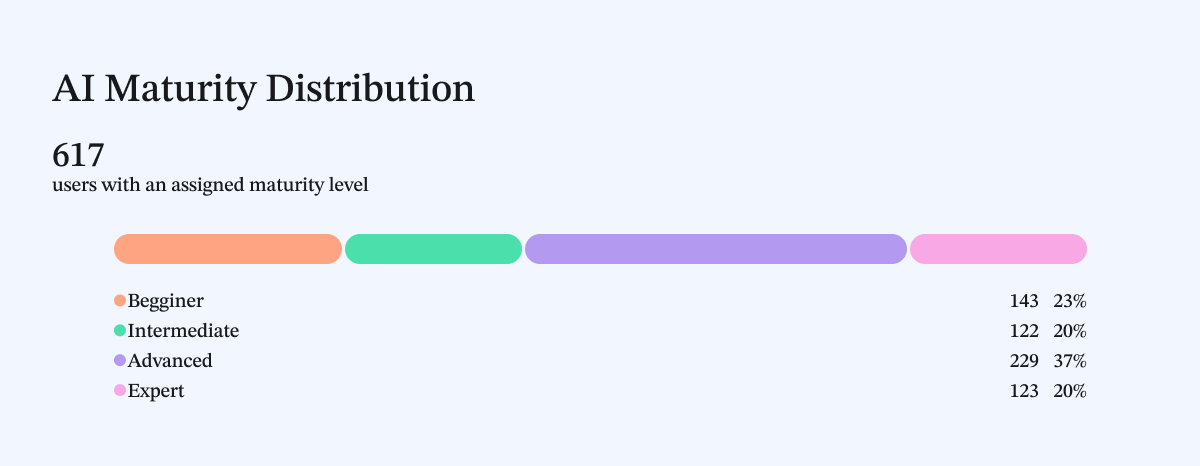
The most striking finding is that 57% of the assessed users are already at an Advanced or Expert level. More than one in three (37%) fall into the Advanced category alone, meaning they are comfortable using AI for more demanding tasks, such as analyzing files, cross-referencing information, and generating comprehensive reports. Crucially, they also understand the importance of verifying AI-generated results before relying on them.
This is an encouraging starting point for the next generation of AI-powered features. Rather than assuming that users need to be introduced to AI from scratch, we can already build on a substantial group of people who understand its potential, recognize its limitations, and know how to incorporate it into their work. It also suggests there is room to explore more sophisticated and autonomous AI experiences, provided that the right safeguards and levels of control remain in place.
AI maturity is not the same across markets.
Looking beyond the overall distribution, we also found meaningful differences between markets. Portugal, for example, has a higher proportion of Beginners than Spain. This suggests that, even within relatively close markets, users may have different levels of familiarity and confidence when it comes to applying AI in their daily work.
Mozambique presents a particularly interesting result: it has the highest proportion of Expert users, with approximately one-third of its assessed users falling into this category. However, this finding should be interpreted with caution, as it is based on a very small sample of just nine users and may not be representative of the wider market.
These differences are a useful reminder that AI adoption does not follow a universal pattern. A single onboarding experience or training approach may work well for some users while leaving others behind or unnecessarily slowing down those who are already comfortable with more advanced use cases.
The takeaway is clear: our users do not all start from the same place, and our products should not treat them as if they did. Understanding these differences gives us the opportunity to make AI integration more relevant to each market, offering more basic guidance where needed, while allowing more experienced users to explore the full potential of AI. Ultimately, assessing AI maturity is not just about knowing how many people use it. It is about understanding what they are capable of doing with it, how responsibly they use it, and what they need from us to take the next step. And these results suggest that we may be able to go further, faster, than we initially thought.